
To truly understand the soul of an Odisha handloom saree, one must first travel back in time. Long before power looms and synthetic dyes flooded the global textile market, the artisans of ancient Kalinga (modern-day Odisha) were weaving masterpieces out of pure silk and cotton. The history of Odisha handloom is not just a chronicle of textiles; it is the history of a people, their devotion, their temple architecture, and their profound connection to the divine.
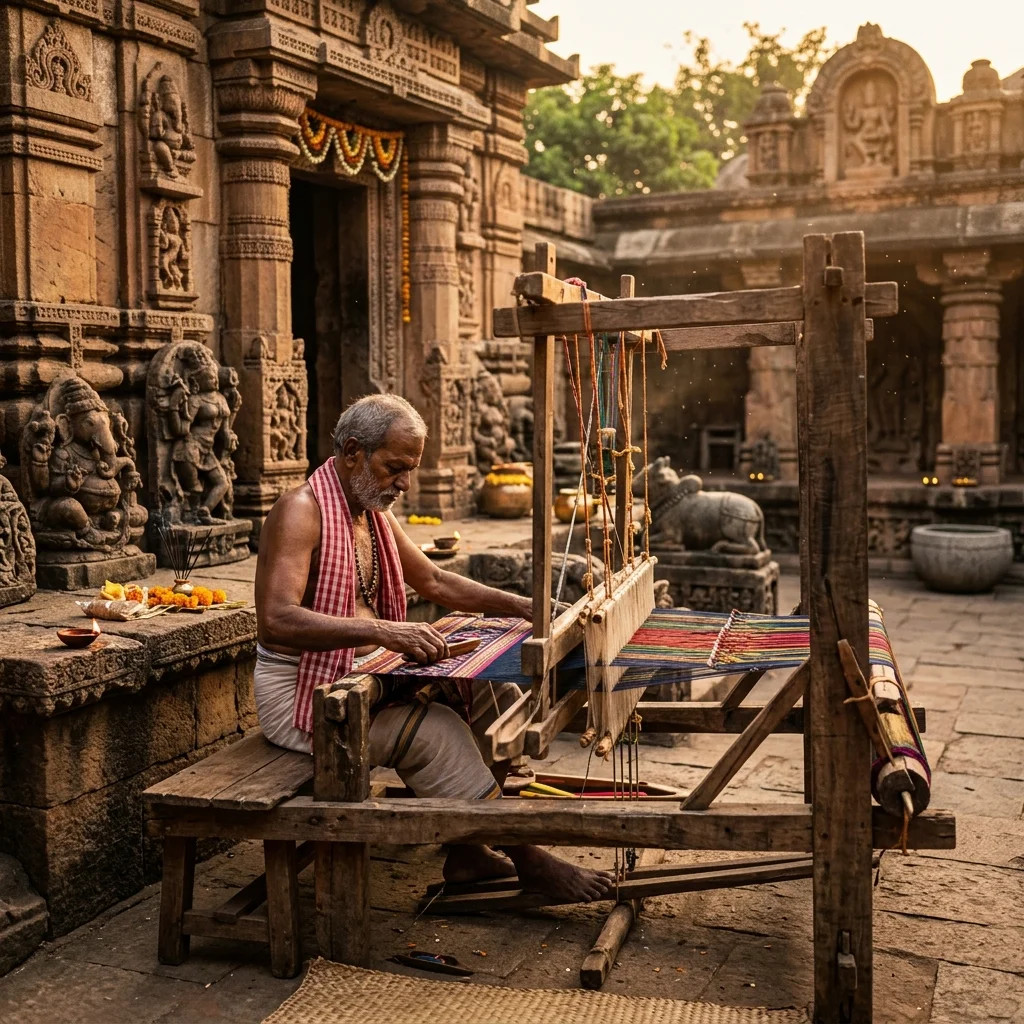
For over 2,000 years, the rhythmic clack of the wooden shuttle has echoed through the mud-brick homes of Odisha's weaving villages. In a state deeply intertwined with the worship of Lord Jagannath, weaving was never merely a commercial enterprise. It was a sacred duty. The earliest records of Odisha’s textile brilliance can be traced back to the ancient maritime trade routes, where ships laden with vibrant, tie-and-dyed Ikat fabrics sailed from the ports of Kalinga to Southeast Asia, Rome, and beyond.
The Sacred Threads: A Connection to Lord Jagannath
The genesis of Odisha’s most famous weaves is inextricably linked to the Jagannath Temple in Puri. Traditional weaves like the Khandua silk were originally created to drape the deities—Lord Jagannath, Lord Balabhadra, and Devi Subhadra. The weavers of Nuapatna, a small cluster in the Cuttack district, were officially appointed as the 'Sevaks' (servants) of the temple. Their sole responsibility was to weave the Khandua Pata, a silken cloth adorned with verses from the Gita Govinda written in Ikat.
This deep religious significance meant that the weavers adhered to strict rules of purity. Natural dyes were sourced from the earth—red from the roots of the Aal tree, yellow from turmeric, and black from iron rust. The motifs woven into the fabric were not random geometric shapes; they were symbolic representations of the universe. The conch (Shankha), the wheel (Chakra), the lotus (Padma), and the majestic elephant and lion were carefully mathematical expressions of devotion, tied and dyed into the threads before they ever touched the loom.
"A machine can weave cloth, but only human hands guided by centuries of devotion can weave a legacy."
The Mastery of Bandha (Odisha Ikat)
While the temple town of Puri anchored the spiritual side of weaving, the western regions of Odisha—specifically Sambalpur, Bargarh, and Sonepur—were perfecting a mathematical miracle known as Bandha Kala (the art of tie-and-dye).
Unlike modern printing where a design is stamped onto a finished white cloth, Bandha requires the weaver to dye the individual threads before they are woven. The artisan visualizes the final pattern, counts thousands of incredibly fine silk threads, ties them tightly with rubber or leaves to resist the dye, and dips them into boiling vats of color. This process is repeated multiple times for multi-colored designs. When the dyed threads are finally mounted on the loom and woven together, the pattern magically emerges. The defining characteristic of authentic Sambalpuri Ikat is its slightly blurred edge—a beautiful, undeniable proof that the pattern was created by aligning dyed threads by hand, not printed by a machine.
During the 12th century, under the patronage of the Somavamsi and Ganga dynasties, this art form flourished. Royal families adorned themselves in heavy Bomkai and Pasapali silks. The Pasapali motif, characterized by contrasting checkerboard patterns, was inspired by the ancient game of Pasha (similar to Ludo) played by the royals. Today, these intricate designs remain highly sought after by connoisseurs of Indian heritage.
The Loom Goes Silent: The Threat of Modernization
Fast forward to the 21st century. The industrial revolution and the advent of power looms brought cheap, mass-produced textiles to the market. Suddenly, a saree that took a master weaver 30 days to create could be mimicked and printed by a machine in 30 minutes. The market was flooded with synthetic fakes.
Because genuine handlooms require immense time, skill, and physical labor, the cost is naturally higher. Middlemen exploited this gap, purchasing authentic sarees from illiterate weavers for pennies and selling them in urban boutiques for exorbitant margins. The true creators—the traditional weaving families of Odisha—were left impoverished. Many master weavers abandoned their ancestral craft, urging their children to seek jobs in cities as daily wage laborers. The 2,000-year-old legacy was on the brink of extinction.
The Renaissance: Protecting the Weavers
This brings us to the core mission of Utkal Aditri. We recognized that the only way to save the history of Odisha handloom was to save the weavers themselves. We bypassed the middlemen entirely, establishing a zero-fee platform that connects 150 master weaving families directly to you, the buyer.
When you purchase an authentic Odisha handloom saree from our Shop, you are not just buying six yards of fabric. You are funding the education of a weaver's child. You are ensuring that the rhythmic clack of the wooden loom continues to echo through the villages. You are holding a piece of history in your hands—certified by the Silk Mark, deeply rooted in the traditions of Lord Jagannath, and woven with a level of love and devotion that no machine could ever replicate.
Be A Part Of The History
Explore our curated collection of 100% authentic, Silk Mark certified Odisha handloom sarees. Shipped directly from the weaver's home to yours.
Explore The Collection